
Ep 025 From Suffrage to Civil Rights: How We Have Used Quilts to Amplify Our Voices
SPOTIFY | APPLE | YOUTUBE
A Historical Look at Activism and Expression in Quilts
If you've spent any time in the social media side of quilting, you've probably seen some variation of the phrase “leave politics out of quilting!”.
In this episode, I'm diving into a topic that makes some people uncomfortable—and I think that's exactly why we need to talk about it. We're exploring how quilters throughout American history have used their quilts to amplify their voices, bring awareness to causes, financially support organizations, and influence society at large.
Spoiler alert: that sounds like politics to me…
Before we go further, let me be clear about what this episode isn't. I'm not here to tell you my personal political opinions or convince you to vote a certain way. I'm also not a professional historian—I'm a quilter with a deep interest in our tradition who does her best to dig into concepts worth exploring. You won't leave this episode knowing how I vote, but you will leave with a better understanding of quilting's rich history of activism and expression.
Why This Conversation Matters
Here's what's bothering me: when we tell our fellow quilters to "leave politics out of quilting," we're dismissing centuries of tradition laid by generations of quilters who came before us. To say "quilting is not political" is to ignore the historical realities of the very tradition in which we are partaking..
Quilting has historically been a way for marginalized, oppressed, and ignored communities to tell their stories. Women—who historically couldn't own land, access education, or even vote (until 1920) —used quilts to write their names into the historical timeline in a nontraditional way. Women and other marginalized folks have used fabric and thread to document experiences that history books often overlooked.
As the International Quilt Museum puts it: "To look at the visual qualities of quilts alone… is to neglect the complex roots of American quiltmaking generally and the individual quiltmakers' stories specifically."
A Framework for Understanding Activist Quilts
Dr. Teri Walker, a professor of political science at Elmhurst University, presented a framework I find helpful when approaching activist quilts:
How do I feel when I see this quilt? (immediate reaction)
Is the message overt or subtle?
What is the message of this quilt?
Does the color, wording, pattern, or quilting affect the delivery of the message, and how?
Will this quilt entice me to think differently or take action? If so, how?
This framework helps us set aside our conditioning and really see what quilters are communicating through their work.
You can find Dr. Walker’s lecture presented by The International Quilt Museum here.
Four Historic Examples of Political Quilting
1. The Boston Female Anti-Slavery Society Cradle Quilt (1836)
The earliest-known fundraising quilt raffled by the Boston Female Anti-Slavery Society. This sawtooth star quilt features a center square with a poem attributed to Quaker woman Elizabeth Margaret Chandler, and is a heartbreaking verse about the horror of enslaved children being torn from their families. This quilt was sold at an Anti-Slavery Fair to raise funds for the abolitionist movement— talk about direct political action through quilting!
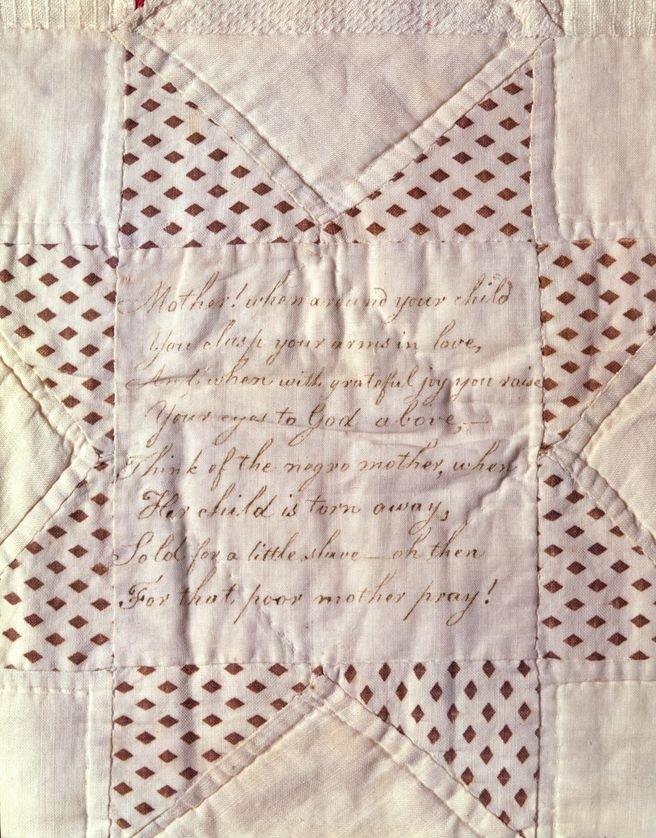
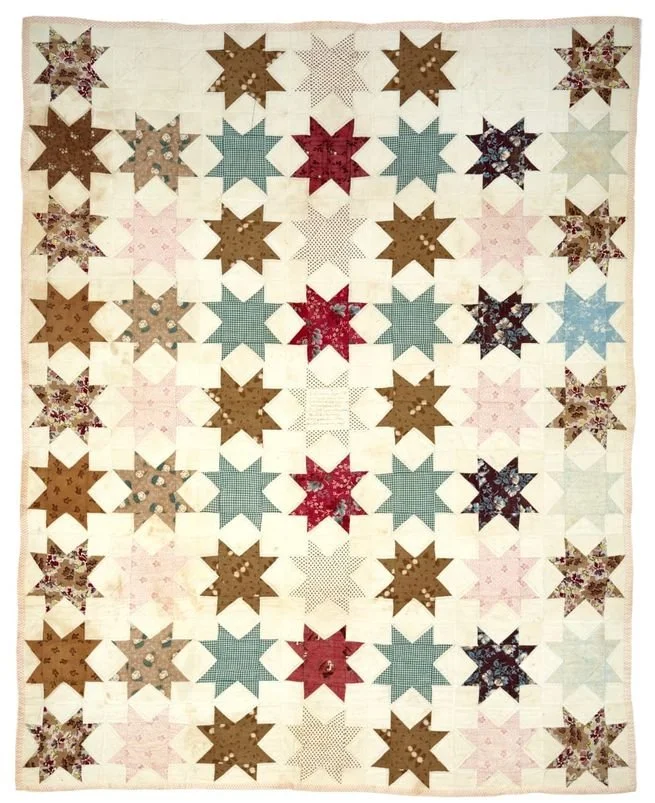
Photo credit: Historic New England Collection. Read more about the Anti-Slavery Cradle Quilt on their website, linked HERE.
2. The Hoosier Suffrage Quilt (before 1920)
Created before the 19th Amendment granted women the right to vote, this quilt features nearly 300 embroidered names of farming and working-class families from northwestern Indiana who each gave donations support the women's suffrage movement. The quilt was then sold at auction to raise even more funds for the cause. The quilt design plays on the American flag motif with alternating red and white stripes and stars on a blue background.
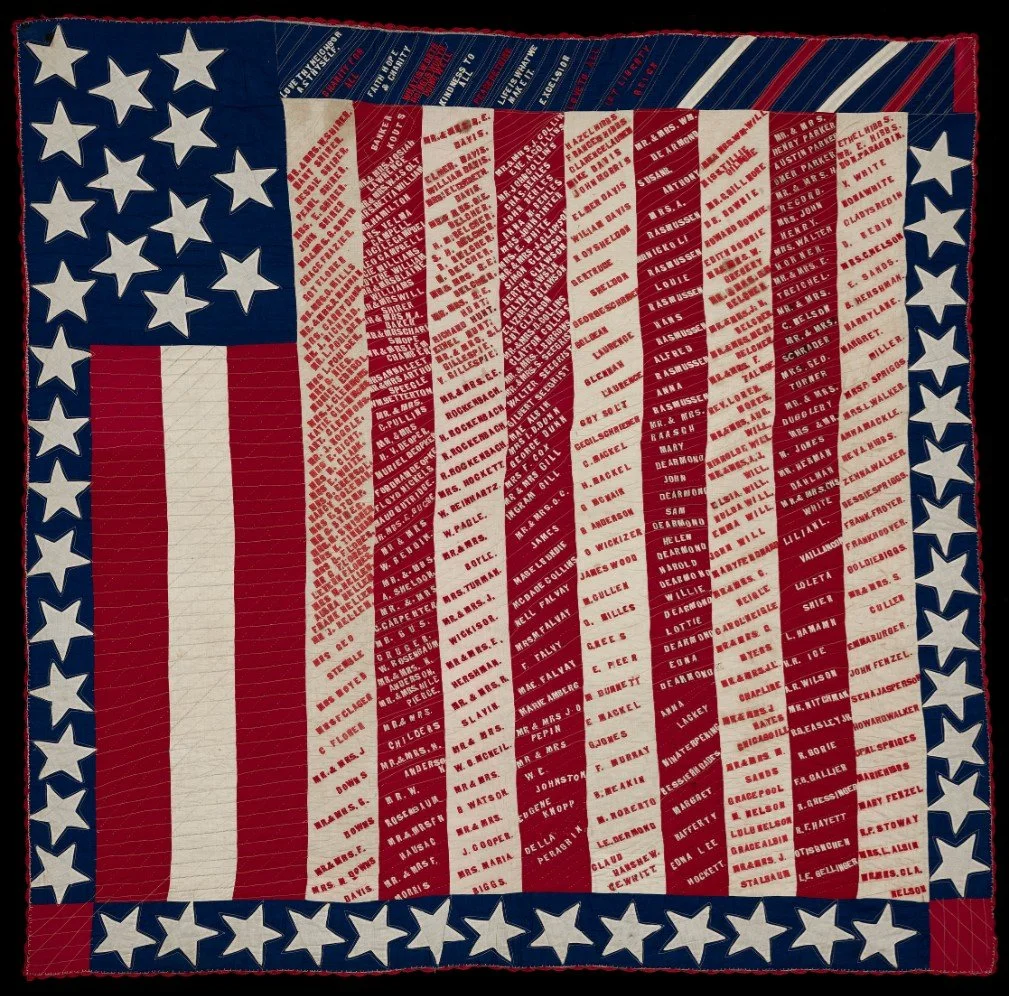
Photo Credit: Museum of Fine Arts Boston. Read more about the Hoosier Suffrage Quilt and it’s fellow quilts that make up the Fabric of a Nation exhibit at the MFA Boston website, linked HERE.
3. Freedom Quilt by Jessie “Sis” Telfair (1970s)
Made in Georgia by a woman, Jessie Telfair, who lost her job after registering to vote during the Civil Rights Movement. Jessie created at least four versions of this design, which integrates lettering patterns published in a Ladies Art Company publication, as a means of working through her grief and anger at systemic oppression. There is some speculation that more than one version of this quilt was made to generate income through a quilting co-op. Jessie’s FREEDOM quilts now hang in museums, including the Smithsonian's National Museum of African American History and Culture, and are a testament to how quilting documents experiences that might otherwise be forgotten.
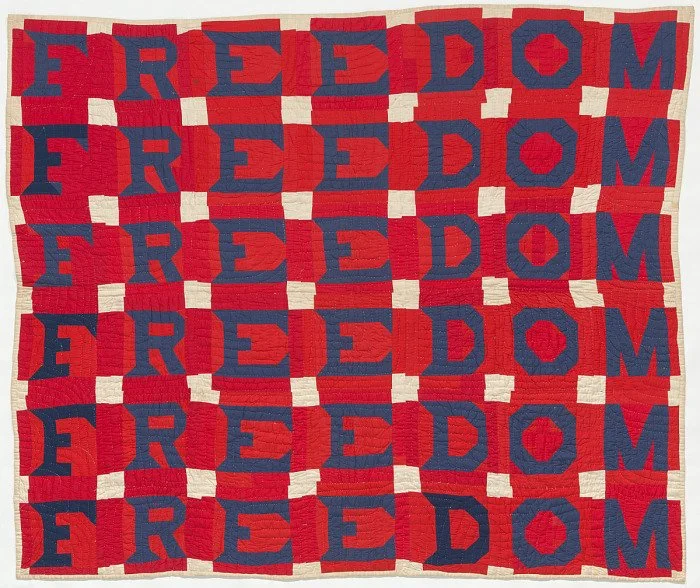
Read more about this particular version of Jessie’s FREEDOM Quilt from the Smithsonian National Museum of African American History and Culture HERE.
4. The AIDS Memorial Quilt (1987-present)
The largest community art project ever created, this 54-ton quilt features over 50,000 panels commemorating more than 110,000 lives lost to HIV/AIDS. The idea for a memorial quilt began with human rights activist Cleve Jones in 1985, and the quilt was first displayed on the National Mall in 1987 with 1,920 panels. Over half a million people visited the quilt exhibition that weekend. Even today, new panels continue to be made, and sections display in communities across the country. This quilt brings awareness and a voice to a crisis that was once shadowed by fear, silence, discrimination, and stigma, and continues to ensure that the voice of the victims of this terrible disease are not forgotten.
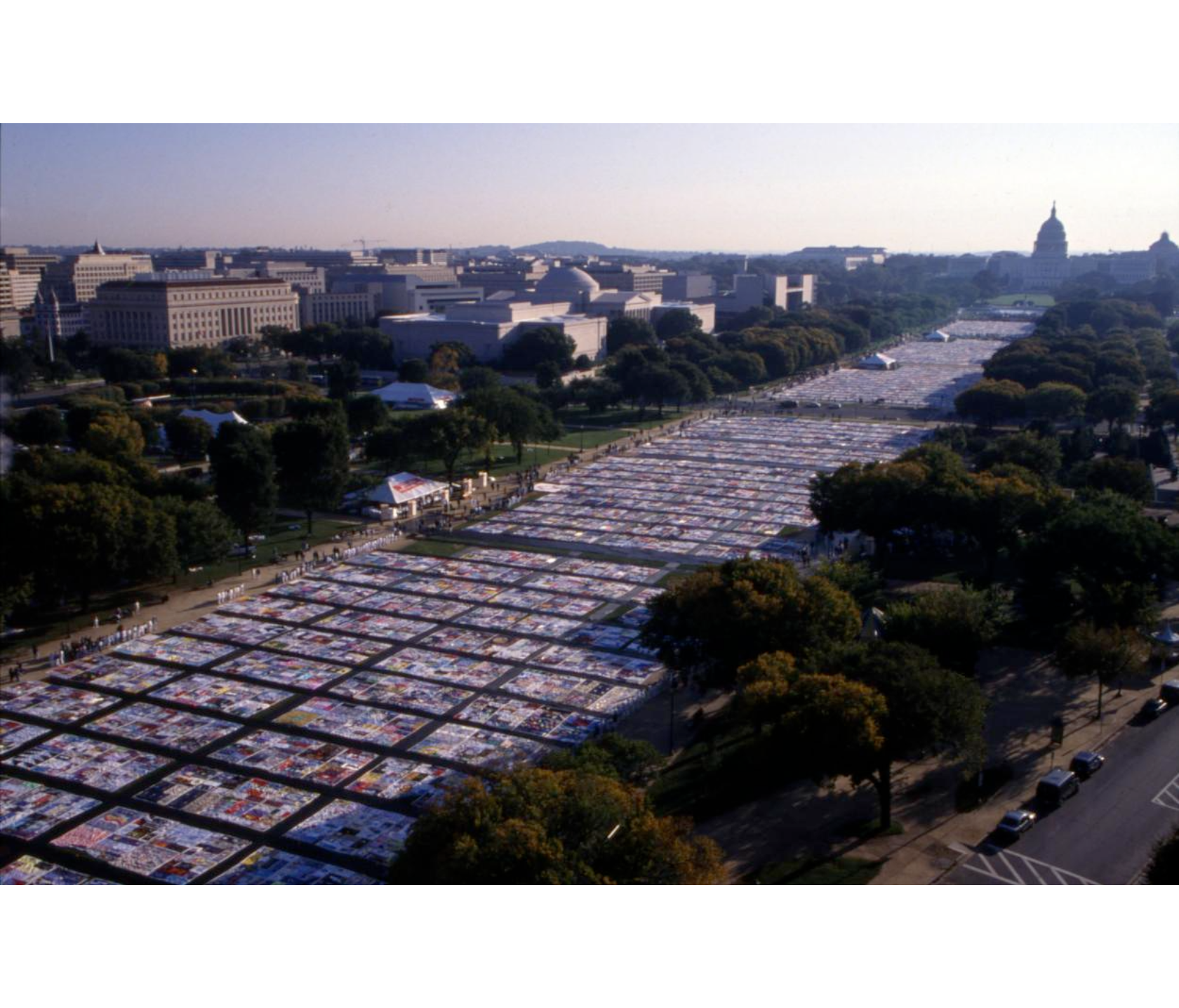
The AIDS Memorial Quilt on the National Mall in 1996, after nearly a decade’s worth of panels had been made.
Read more about the AIDS Memorial Quilt on the National AIDS Memorial website, linked HERE.
A final message:
I wanted to end this week’s episode by asking if you've ever made a quilt as activism, protest, or self-expression. But I think the better, more unifying question is this: have you ever made a quilt that DID NOT reflect your experience and interpretation of your world?
I know that I never have. Every quilt I make holds my hopes, dreams, stories, and prayers for the world around me. They' feel like literal extensions of my heart and soul. I think we'd be hard-pressed to find a quilter who can look with complete indifference on something they spent hours making, and claim it has no message to send out into the world.
Even if it's an unspoken message, it's still there in thousands of stitches.
And its voice is worthy of being heard.
Until next time,

Connect With This Episode:
Subscribe to the Patchwork Revival Podcast wherever you get your podcasts. Your quilts tell stories—let's honor the tradition of quilters who used their voices before us.
LINKS to support the podcast can be found HERE!
Don’t forget that podcast listeners can enjoy 15% off in the
Patchwork Revival pattern shop with code: REVIVAL at checkout!